For South Africans traveling overseas, staying connected is no longer a luxury – eSim for South African travellers solves the void. It is a necessity tied to safety, banking access, navigation, work, family communication, and peace of mind. Yet international roaming remains one of the most common travel pain points, often ending in unexpected bills, slow speeds, and constant anxiety about switching data on or off.
There is a smarter way to stay connected overseas without roaming shock. It is already being used by informed South African travelers who value control, predictability, and seamless global movement. This guide explains that solution in full, using clear language, real world travel logic, and technology that aligns with how modern smartphones and global networks actually work.
South African travelers face unique connectivity challenges when leaving the country. Local mobile networks are strong at home, but once you cross borders, the experience changes dramatically.
International roaming agreements vary by destination, network partner, and even region within a country. Data speeds can fluctuate, coverage can drop without warning, and billing structures are often unclear until the bill arrives. For families, business travelers, and religious pilgrims, these uncertainties create stress at moments when focus should be on the journey itself.
Connectivity overseas is not just about social media. It supports essential functions like:
Accessing banking apps and one time passwords
Using maps, transport apps, and hotel check ins
Communicating on WhatsApp with family back home
Receiving airline, accommodation, and travel alerts
Staying reachable for work or emergencies
When connectivity fails, the emotional cost often outweighs the financial one.
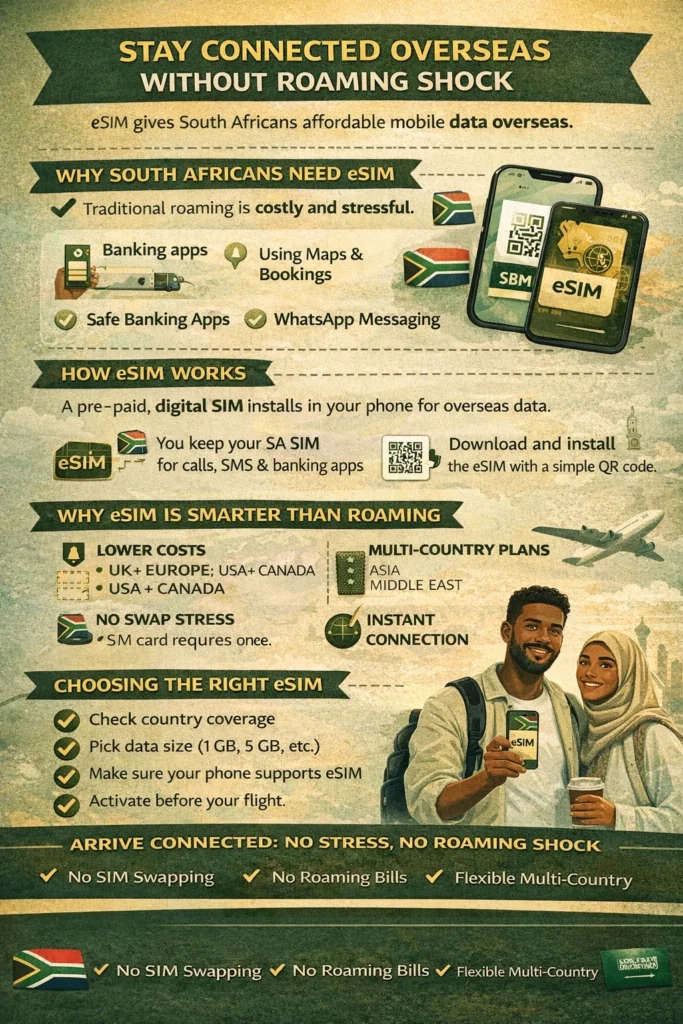
Roaming shock is not just about high prices. It is about loss of control.
Most roaming charges are usage based, calculated after the fact, and tied to unfamiliar terms. South Africans often travel with data switched off, check usage obsessively, or rely on unstable public WiFi. This creates a constant background anxiety that disrupts the travel experience.
Psychologically, roaming shock triggers fear of loss and uncertainty. You do not know how much data costs in real time. You do not know which apps are consuming background data. You do not know what the final bill will look like.
The smarter solution removes uncertainty before the journey even begins.
An eSIM is a digital SIM built into your smartphone. It allows you to activate a mobile data plan without inserting a physical SIM card. For South Africans traveling overseas, this means you can buy and activate an international data plan before you leave home.
Your physical South African SIM stays in your phone. Your WhatsApp number remains active. Your banking messages still arrive. The eSIM simply handles your overseas data connection.
This shift is important because it changes connectivity from a reactive problem into a planned decision.
Most newer iPhone and Android devices support eSIM technology. Once you purchase an eSIM plan, you receive a QR code or activation link. You scan it, install the profile, and choose when to activate it.
Key technical benefits include:
No SIM swapping at airports
No risk of losing your local SIM
Instant activation in supported countries
Ability to switch between networks digitally
From a search engine perspective, eSIM is now a core entity linked to international travel, mobile data, smartphones, and roaming alternatives. From a human perspective, it offers simplicity and confidence.
The decision to use an eSIM is driven by practical reasons.
Practically, eSIM plans are often cheaper than roaming. They provide clear data limits, fixed pricing, and multi country coverage.
Parents rely on maps, bookings, messaging, and emergency access. eSIM allows the whole family to stay connected without sharing hotspots or worrying about costs.
Stable data is essential for emails, video calls, document access, and navigation in unfamiliar cities.
Pilgrims depend heavily on mobile data for coordination, guidance apps, and staying in touch with family. Reliable connectivity is not optional in these journeys.
eSIM plans often cover multiple destinations, making them ideal for Europe, Asia, or Middle East travel without changing SIMs.
Choosing the right eSIM is about matching the plan to your travel behavior.
Consider the following:
Destination coverage and supported countries
Data amount based on trip length and usage habits
Device compatibility with your smartphone model
Activation timing, either before departure or on arrival
Avoid choosing purely on price. Reliability, network partners, and ease of support matter more when you are thousands of kilometers from home.
Check if your smartphone supports eSIM
Purchase an international eSIM plan online
Install the eSIM using the provided instructions
Set the eSIM as your primary data line
Activate data roaming for the eSIM only
Test connectivity before departure if possible
This preparation eliminates uncertainty and creates a smooth arrival experience.
Waiting until arrival to sort out data
Relying solely on public WiFi
Turning on roaming without understanding costs
Buying airport SIMs without coverage clarity
Each of these increases stress and reduces travel enjoyment.
Does eSIM work with dual SIM phones?
Yes. Most eSIM compatible phones support dual SIM functionality.
Can I top up or change plans while overseas?
In most cases, yes. Many eSIM providers allow online top ups.
Is eSIM safe and secure?
Yes. eSIMs use the same network security standards as physical SIMs.
Will my apps work normally?
Yes. WhatsApp, banking apps, maps, and social apps function as usual.
© 2026 Travel in Class. All rights reserved.